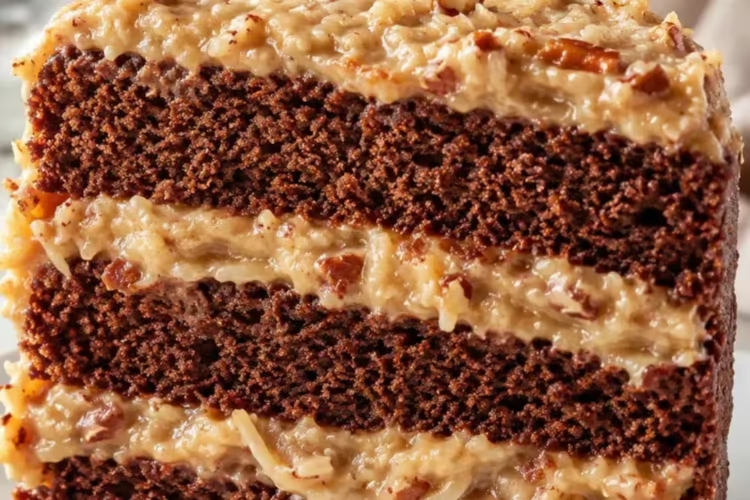
There’s a particular kind of quiet that falls over a kitchen when a German chocolate cake comes out of the oven. That first whiff of dark cocoa mingling with toasted coconut and pecans has a way of pulling you straight back to childhood — standing on a step stool, “helping” more than actually helping, waiting for the bowl to lick. For a lot of us, this cake isn’t just dessert. It’s a birthday. A Sunday dinner. A grandmother’s handwriting on a recipe card gone soft at the corners.
If you’ve never baked one yourself, or you’ve tried and ended up with runny frosting and a lopsided cake, you’re in the right place. By the end of this guide, you’ll know exactly how to put together a truly delicious German chocolate cake — one that tastes like a memory, even if this is the first time you’ve made it.
Table of Contents
What Is German Chocolate Cake? (And Why It’s Not From Germany)
Here’s something that surprises almost everyone the first time they hear it: German chocolate cake has nothing to do with Germany. You’d be forgiven for assuming otherwise — the name practically begs for the mix-up. But the “German” in the title refers to a person, not a country.
The Surprising American Origin Story
Back in 1852, an English-American baker named Samuel German developed a new kind of baking chocolate. It was darker and sweeter than the semisweet bricks bakers typically worked with, which meant home cooks didn’t have to add as much sugar to their own recipes. Samuel sold the formula to the Baker’s Chocolate Company, and they named the product in his honor: “Baker’s German’s Sweet Chocolate.”
Notice that little apostrophe-S. That single possessive is the whole reason for the confusion that followed.
For about a century, German’s Sweet Chocolate mostly showed up in puddings and frostings — nothing you’d call a signature dish. Then, in 1957, a Dallas homemaker named Mrs. George Clay sent in a cake recipe built around that chocolate. It ran as the “Recipe of the Day” in The Dallas Morning News on June 3, 1957. General Foods, which owned the Baker’s brand by then, picked up the recipe and syndicated it to newspapers around the country. Sales of the chocolate reportedly jumped, and a regional recipe turned into a national favorite almost overnight.
Somewhere along the way, as the cake spread from kitchen to kitchen, the possessive “German’s” quietly lost its apostrophe and its S. What started as “German’s Chocolate Cake” — a cake made with German’s chocolate — became simply “German chocolate cake,” and the mix-up was born.
Clearing Up the Common Misconception
So if you’ve ever ordered “German chocolate cake” while traveling in Germany and gotten a confused look from your waiter, now you know why. It’s about as German as french fries are French. What you’re actually getting, name aside, is a distinctly American dessert with roots in Massachusetts chocolate mills and Texas home kitchens.
What Makes a Delicious German Chocolate Cake So Special
Once you understand where it comes from, the next question is obvious: why has this particular cake stuck around for nearly seventy years? The answer is mostly in the frosting.
The Signature Coconut-Pecan Frosting
Unlike a traditional buttercream, German chocolate cake frosting starts as a cooked custard — egg yolks and evaporated milk simmered together until they thicken — and then gets folded together with toasted pecans and sweetened shredded coconut. It’s spreadable but not smooth, gooey but not sticky-sweet, and it brings a texture you just don’t get from powdered-sugar frostings.
Rich, Tender Chocolate Layers
The cake itself leans mild rather than intensely fudgy, thanks to that sweeter German’s chocolate. Separated eggs — with the whites whipped and folded in near the end — give the crumb a lighter, more delicate structure than a dense chocolate cake, while buttermilk adds both moisture and a faint tang that keeps the whole thing from tasting flat.
Put those two elements together, and here’s what you end up with:
- A balanced sweetness that never tips into “too rich to finish a slice”
- A textural contrast between soft cake and chewy, crunchy frosting
- A naturally photogenic layer-cake shape that’s practically made for celebrations
Ingredients for a Delicious German Chocolate Cake
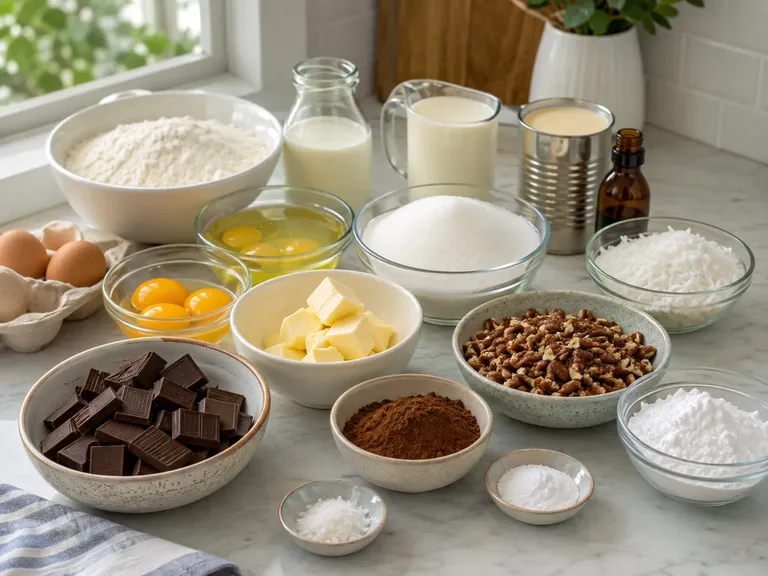
Before you preheat the oven, it helps to see everything laid out. Here’s exactly what you’ll need.
Cake Layer Ingredients
| Ingredient | Amount | Notes |
|---|---|---|
| German’s sweet baking chocolate | 4 oz | You can substitute bittersweet chocolate in a pinch |
| All-purpose flour | 2 ¼ cups | Spoon and level it — don’t scoop straight from the bag |
| Baking soda | 1 tsp | |
| Salt | ¼ tsp | |
| Unsalted butter, softened | 1 cup | |
| Granulated sugar | 2 cups | |
| Egg yolks | 4 large | Separated from the whites |
| Egg whites | 4 large | Whipped separately for lift |
| Buttermilk | 1 cup | Adds tang and tenderness |
| Vanilla extract | 1 tsp |
Coconut-Pecan Frosting Ingredients
| Ingredient | Amount | Notes |
|---|---|---|
| Evaporated milk | 1 cup | Not the same as sweetened condensed milk |
| Granulated sugar | 1 cup | |
| Egg yolks | 3 large | |
| Unsalted butter | ½ cup | |
| Vanilla extract | 1 tsp | |
| Sweetened shredded coconut | 1 ⅓ cups | |
| Chopped pecans | 1 cup | Toast them first for deeper flavor |
If you’re baking for someone with dietary restrictions, you’ve got options. A 1:1 gluten-free flour blend works well in the cake layers, and you can make a dairy-free buttermilk substitute by stirring a tablespoon of vinegar into a cup of plant milk and letting it sit for ten minutes. If someone in your house can’t have coconut, a vanilla custard frosting makes a reasonable stand-in, though it won’t taste quite like the original.
How to Make Delicious German Chocolate Cake (Step-by-Step)
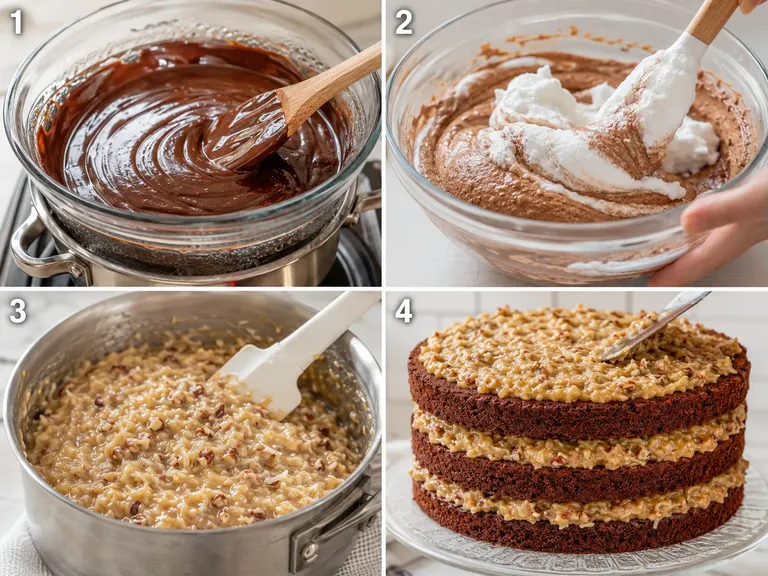
Now for the part you’ve been waiting for. Give yourself about two hours from start to finish, including cooling time.
Prepping and Baking the Cake Layers
- Melt the chocolate gently — a double boiler or short bursts in the microwave both work — and set it aside to cool slightly.
- Cream the butter and sugar together until the mixture turns pale and fluffy, then beat in the egg yolks one at a time.
- Mix in the cooled melted chocolate and vanilla.
- Alternate adding the dry ingredients and buttermilk into the batter, starting and ending with the flour mixture. Mix just until combined — this is not the moment to walk away and let the mixer run.
- In a separate bowl, whip the egg whites to soft peaks, then gently fold them into the batter. You’re looking to keep air in the mixture, not knock it out.
- Divide the batter evenly between your prepared pans and bake at 350°F (175°C) for 25 to 30 minutes, until a toothpick comes out clean.
Making the Coconut-Pecan Frosting
- Whisk the evaporated milk, sugar, and egg yolks together in a saucepan.
- Cook over medium heat, stirring constantly, until the mixture thickens — this usually takes around 12 minutes. You’ll know it’s ready when it coats the back of a spoon.
- Remove the pan from the heat and stir in the butter, vanilla, coconut, and pecans.
- Let the frosting cool to a spreadable consistency before you touch your cake layers with it.
Assembling the Cake
Once your layers have cooled completely and your frosting has thickened, stack the layers with frosting between each one, then finish the top. Traditionally, German chocolate cake leaves the sides bare, letting the frosting drip slightly and the chocolate cake peek through — it’s a distinctive look, and honestly, it saves you a step.
Pro Tips for a Moist, Delicious German Chocolate Cake
- Check the cake at the 25-minute mark rather than waiting the full 30 — overbaking is the single biggest reason this cake turns out dry.
- Pull your eggs and butter out ahead of time so they’re at room temperature; cold ingredients don’t blend evenly.
- Toast the pecans and coconut in a dry skillet for a few minutes before adding them to the frosting. It makes a bigger flavor difference than you’d expect.
Common Mistakes to Avoid
- Overmixing after adding the flour. This develops gluten and leaves you with a dense, tough cake instead of a tender one.
- Frosting warm layers. The heat will melt the frosting right off the sides, so give the cake plenty of time to cool first.
- Grabbing sweetened condensed milk instead of evaporated milk. They’re not interchangeable — one is unsweetened and one is loaded with sugar, and swapping them will throw off the whole frosting.
Delicious German Chocolate Cake Nutrition Facts
Worth knowing before you cut yourself a second slice: this is a rich dessert, and the numbers below reflect a standard two-layer, 8- to 9-inch cake cut into 12 slices. Exact values will shift depending on your specific recipe and portion size.
| Nutrient | Amount (per slice) |
|---|---|
| Calories | ~400 kcal |
| Total Fat | ~20 g |
| Saturated Fat | ~6 g |
| Carbohydrates | ~54 g |
| Sugars | ~36 g |
| Protein | ~4 g |
| Sodium | ~360 mg |
(Figures based on standard nutrition database estimates for a two-layer German chocolate cake with icing and filling.)
If you’re watching your intake but don’t want to skip the cake entirely, a few swaps go a long way:
- Replace half the butter in the cake layers with unsweetened applesauce
- Use light evaporated milk in the frosting instead of the full-fat version
- Cut the sugar by about a quarter cup — you likely won’t notice the difference
Variations on the Classic Delicious German Chocolate Cake
Once you’ve got the base recipe down, there’s plenty of room to make it your own:
- Cupcakes — perfect for portion control and easy for parties, since nobody has to fight over slice sizes
- Sheet cake — a smart move if you’re feeding a crowd or bringing dessert to a potluck
- Bundt cake — a different presentation that still delivers the same flavor combination
- Gluten-free version — swap in a 1:1 gluten-free flour blend with minimal adjustment
- Vegan version — flax eggs plus plant-based butter and milk get you surprisingly close to the original
Storing and Freezing Your Delicious German Chocolate Cake
Because the frosting is egg- and dairy-based, this isn’t a cake you want to leave out on the counter indefinitely.
- Room temperature: Cover it well and it’ll keep for up to 2 days.
- Refrigerated: You’ve got about 5 days — and honestly, refrigeration is the safer bet given the custard-style frosting.
- Freezer: Wrap unfrosted layers tightly and freeze for up to 3 months. Thaw them fully before frosting.
- Frosted slices: You can freeze individual pieces too, which makes for an easy grab-and-go dessert whenever the craving hits.
When to Serve Delicious German Chocolate Cake
This cake has a long history as a celebration dessert, and it fits naturally into:
- Birthdays and holiday gatherings — it’s been a Southern staple at these events for decades
- Potlucks and church socials, where its bare-sided presentation makes it easy to transport
- Quiet weeknights, paired with a strong cup of black coffee, a cold glass of milk, or a scoop of vanilla ice cream on the side
FAQ: Delicious German Chocolate Cake
Is German chocolate cake actually from Germany? No. Despite the name, German chocolate cake is an American creation. It’s named after baker Samuel German, not the country of Germany.
What makes this a truly delicious German chocolate cake recipe? The balance is what sets it apart. Mild, tender chocolate layers meet a rich, custard-based coconut-pecan frosting — that contrast is really the whole point of a delicious German chocolate cake, and it’s why it doesn’t taste like just another chocolate layer cake.
Can I use semisweet chocolate instead of German’s sweet chocolate? Yes, though your cake will turn out slightly less sweet and a bit more intensely chocolatey. If you go this route, consider trimming the added sugar slightly to compensate.
Why is my coconut-pecan frosting runny? Most likely, the custard base wasn’t cooked long enough. It needs to visibly thicken and coat the back of a spoon before you take it off the heat — rushing this step is the most common culprit.
How far ahead can I make a delicious German chocolate cake? You can make both the layers and the frosting up to 2 days in advance, then assemble everything the day you plan to serve it. This actually gives you a better texture than assembling and serving the same day.
Can I make it without pecans or coconut for allergies? You can leave both out, though the flavor and texture will differ noticeably from the classic version. A vanilla custard frosting makes a reasonable substitute base if you need to work around those allergies.
Ready to Bake?
At the end of the day, a delicious German chocolate cake is more than the sum of its coconut, pecans, and chocolate. It’s the kind of dessert that turns an ordinary Tuesday into an occasion and a kitchen into a gathering place. Whether you’re baking it for a milestone birthday or simply because the craving struck, this recipe is built to be shared, sliced generously, and remembered long after the plate is empty.
So go ahead — preheat the oven, pull out that mixing bowl, and give it a try this weekend. And once you do, come back and let us know how it turned out in the comments, or pin this recipe so you’ve got it ready the next time the craving hits. Bake it once, and don’t be surprised if it becomes the cake your own family starts asking for, year after year.